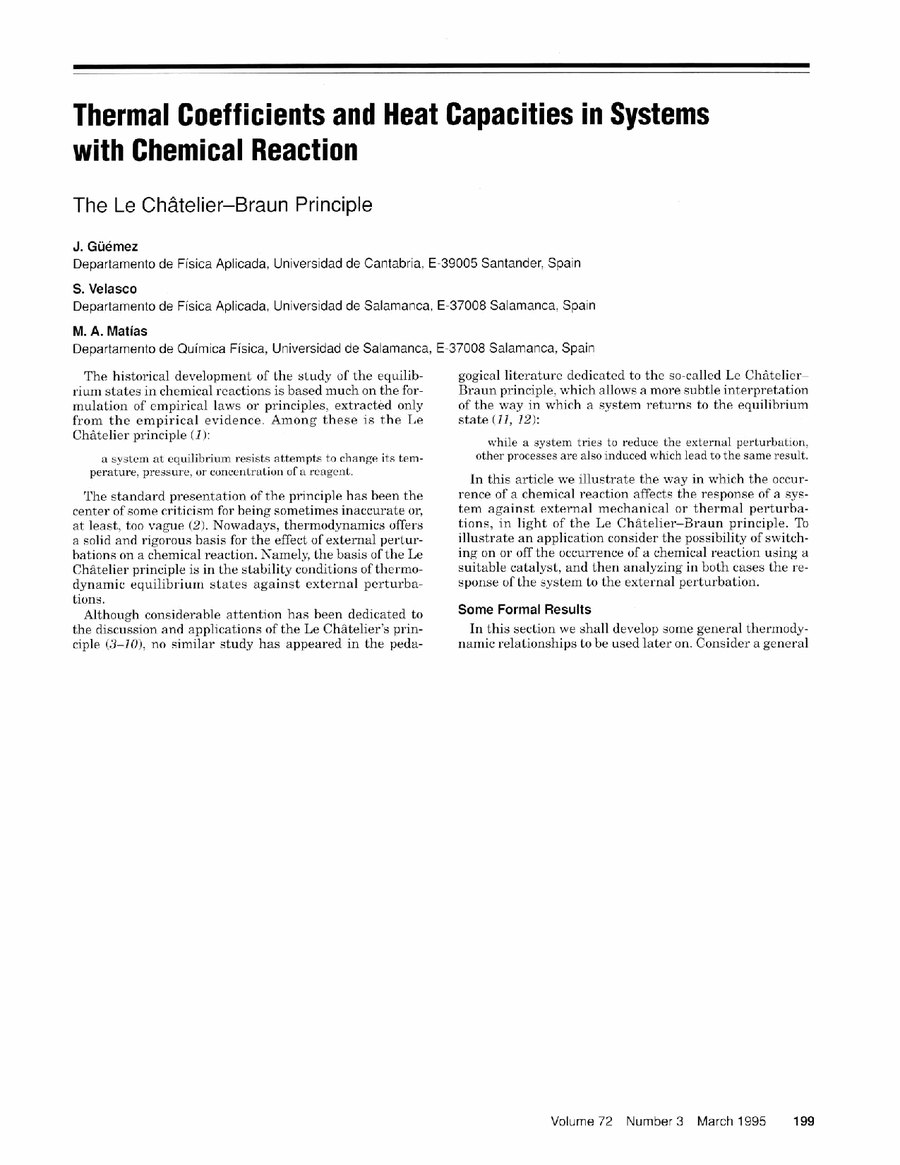
Thermal Coefficients and Heat Capacities in Systems with Chemical Reaction: The Le Châtelier–Braun Principle
J. Güémez, S. Velasco y M. A. Matías
- Publicado en marzo de 1995
- J. Chem. Educ. 72(3), 199–202 (1995)
Resumen
Se ilustra cómo la posibilidad de que ocurra una reacción química modifica la respuesta de un sistema frente a perturbaciones externas, mecánicas o térmicas, a la luz del principio de Le Châtelier–Braun. Tomando como variables conjugadas el grado de avance de la reacción, $\xi$, y la afinidad, $\mathcal{A}$, se obtienen expresiones para la compresibilidad isoterma y adiabática, el coeficiente de dilatación térmica y las capacidades caloríficas a presión y a volumen constantes de un sistema en el que puede producirse una reacción química. Cada coeficiente resulta ser la suma del que tiene el sistema sin reacción ($\xi$ constante) y de una contribución de la reacción, que depende del calor de reacción, $\Delta_{\mathrm{r}}H$, y del volumen de reacción, $\Delta_{\mathrm{r}}V$. Las condiciones de estabilidad termodinámica permiten interpretar los resultados: las compresibilidades y las capacidades caloríficas aumentan cuando la reacción puede producirse (por ejemplo, en presencia de un catalizador), mientras que la contribución de la reacción a la dilatación térmica puede tener cualquier signo, lo que abre la posibilidad de coeficientes de dilatación negativos. Como ejemplo se desarrolla una mezcla reactiva de gases ideales.
El artículo no incluye resumen; este se ha redactado para esta web a partir de su texto.
Abstract
The article shows how the possibility of a chemical reaction modifies the response of a system to external mechanical or thermal perturbations, in the light of the Le Châtelier–Braun principle. Taking the extent of reaction, $\xi$, and the affinity, $\mathcal{A}$, as conjugate variables, expressions are obtained for the isothermal and adiabatic compressibilities, the thermal expansion coefficient and the heat capacities at constant pressure and constant volume of a system in which a chemical reaction may occur. Each coefficient turns out to be the sum of the value for the non-reacting system (constant $\xi$) and a contribution from the reaction, which depends on the heat of reaction, $\Delta_{\mathrm{r}}H$, and the reaction volume, $\Delta_{\mathrm{r}}V$. The thermodynamic stability conditions provide the interpretation: the compressibilities and heat capacities increase when the reaction can take place (for instance, in the presence of a catalyst), whereas the contribution of the reaction to thermal expansion can have either sign, opening the possibility of negative expansion coefficients. A reacting mixture of ideal gases is worked out as an example.
English translation of the summary above.
Leer el artículo completo en Journal of Chemical Education →
Cómo citarlo: J. Güémez, S. Velasco y M. A. Matías, «Thermal Coefficients and Heat Capacities in Systems with Chemical Reaction: The Le Châtelier–Braun Principle», J. Chem. Educ. 72(3), 199–202 (1995).
DOI: 10.1021/ed072p199. El artículo completo pertenece a la revista que lo publica; aquí solo se muestran su primera página y su resumen.